

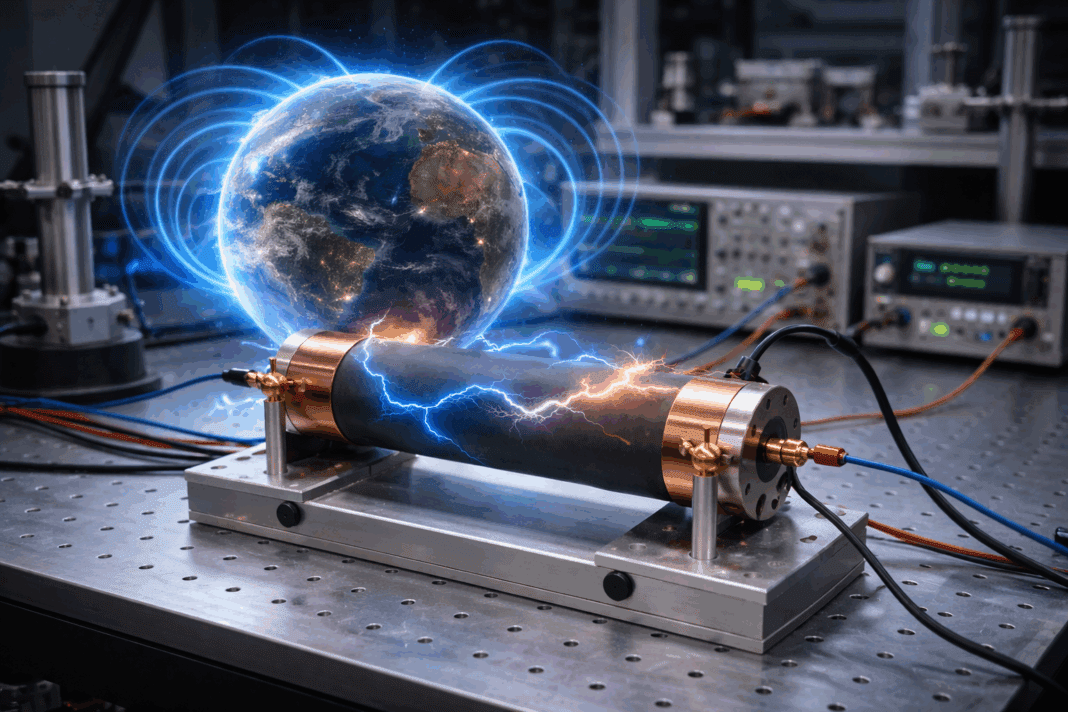

Scientists in the United States have created a small device that produces a tiny electrical signal from Earth’s natural rotation. Although the voltage is extremely small, the experiment shows that Earth’s spin and magnetic field can generate measurable electricity under special conditions, challenging long-standing ideas in physics.
How Earth’s Rotation and Magnetic Field Can Create Electricity
Earth is surrounded by a magnetic field, often described as an invisible shield that protects the planet from harmful space radiation. This magnetic field is created deep inside Earth by the movement of molten metal in the planet’s core. While Earth rotates once every 24 hours, its magnetic field stays mostly fixed in space.
This difference creates an unusual situation. Anything attached to Earth, including buildings, mountains, and laboratory equipment, is constantly moving through this magnetic field. In theory, when a conductor moves through a magnetic field, electric charges inside it should feel a force that pushes them sideways. This force is known in physics as the Lorentz force.
For many years, physicists believed this effect could not produce usable electricity from Earth’s rotation. The reason is that electrons inside a conductor quickly rearrange themselves. As soon as a small voltage appears, the electrons shift just enough to cancel the effect. This cancellation happens incredibly fast, in less than a billionth of a second, making the voltage disappear almost instantly.
Because of this, Earth’s rotation was considered useless as a direct energy source. The new experiment challenges this idea by showing that under very specific conditions, this cancellation does not fully occur. The key lies in the shape of the object and the type of material used.
The device relies on a material that strongly guides magnetic fields but does not easily allow electric current to flow. This unusual combination makes it harder for the electrons inside to completely cancel the magnetic force. As a result, a tiny but steady voltage can remain.
Inside the Tabletop Experiment That Detected the Voltage
The experimental device was a hollow cylinder about one foot long, made from a ceramic material that strongly guides magnetic fields but conducts electricity poorly. The hollow design proved essential, as a solid version of the same material produced no measurable voltage. The cylinder was positioned carefully, aligned roughly north to south and tilted at a precise angle so it stayed perpendicular to both Earth’s rotation and the local magnetic field.
NASA’s 5th Biennial Exercise to tackle Asteroid threats
Electrodes placed at each end of the cylinder measured the electrical signal as Earth rotated. When left undisturbed, the setup produced a steady voltage of only tens of microvolts. Although extremely small, the signal was consistent and measurable. When the device was rotated by 180 degrees, the voltage reversed direction while keeping nearly the same strength. At other angles, the voltage dropped close to zero, matching theoretical expectations.
The researchers also measured a tiny direct current of just tens of nanoamps. Even together, the voltage and current generated power millions of times smaller than what common electronic devices need. To reduce interference, the main tests were done in a quiet underground room. Later measurements in a residential building showed more noise but confirmed the same overall results.
Careful Measurements and Known Physical Effects
To make sure the tiny voltage they measured was real, the scientists carefully checked for other effects that could create false signals in the Electricity readings. One key concern was the Seebeck effect, a well-known process in which a temperature difference across a material can generate its own Electricity.
To rule this out, temperatures at both ends of the cylinder were constantly monitored. Any voltage expected from heat differences was calculated and removed from the data, yet a small Electricity signal linked to Earth’s rotation still remained.
Another important factor was how magnetic fields behave inside materials. In most conductors, magnetic fields move along with the material, allowing electric charges to quickly cancel any Electricity that forms. In this experiment, however, the special material used allowed magnetic fields to pass through more freely. This prevented full cancellation and allowed a tiny electrical signal to persist.
NASA telescope finds bizarre lemon-shaped planet where gravity literally reshaped the world
From a physics point of view, the effect represents an extremely small transfer of energy. A minute amount of Earth’s rotational energy is converted into electrical energy inside the device. The amount is so small that it has no measurable impact on Earth, while still obeying the laws of energy conservation.
The results have sparked debate, as some theories suggest such an effect should not occur. For this reason, researchers stress that independent experiments are needed to confirm or challenge the findings under similar controlled conditions.

