

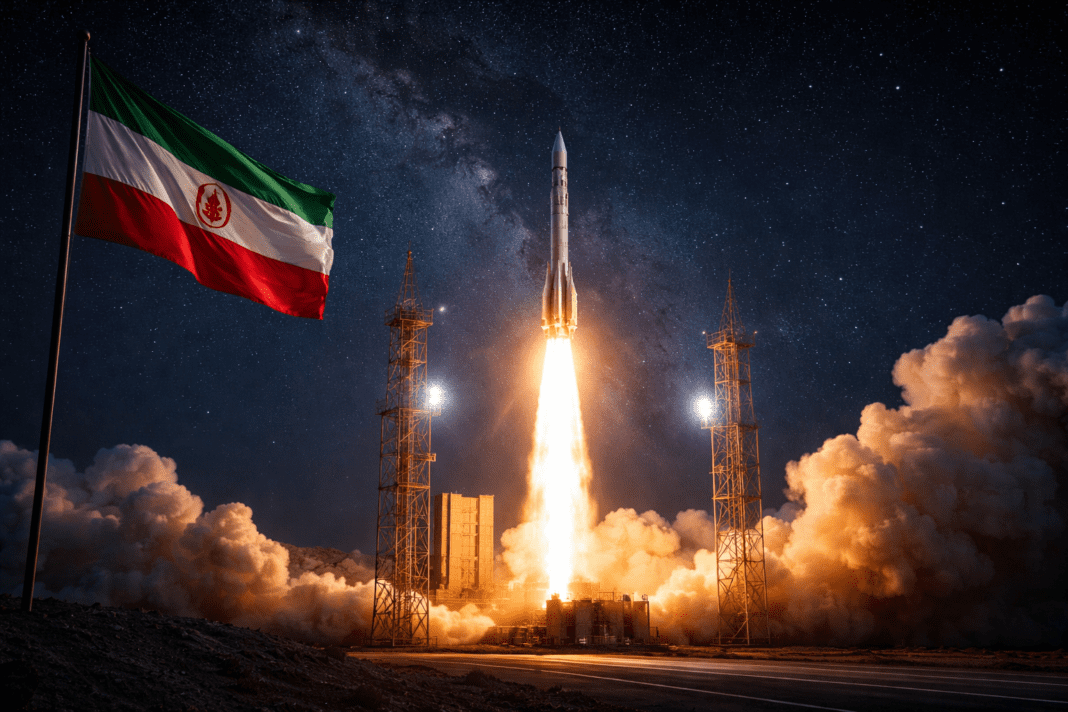

A rocket lighting up the night sky has become a strong symbol of progress and ambition in Iran. From milestones like the launch of the Omid satellite to ongoing advancements, it reflects the country’s growing strength in space technology and its impact on modern life.
A Nighttime Launch That Captures Attention
A rocket rising into the night sky is always a powerful sight. In Iran, such a launch has come to symbolize more than just a scientific event. It represents progress, determination, and a strong push toward technological independence. The bright flame of the rocket cutting through the darkness, along with the national flag, highlights a moment of pride and achievement.
This kind of launch is not just about sending an object into space. It reflects years of hard work in science and engineering. For many people, the image of a rocket climbing into a star-filled sky captures imagination and curiosity. It shows how far human knowledge has come and how nations continue to explore beyond Earth.
The new front line: Why satellite intelligence is becoming Iran’s most powerful weapon
The focus on nighttime launches also adds to the dramatic effect. The glowing trail left behind by the rocket stands out clearly, making the event visually striking. For viewers, it becomes a symbol of ambition and innovation. It also reminds people that space exploration is not limited to a few countries anymore.
The Historic Start of Iran’s Space Journey
Iran made a major step into space exploration in 2009. That year, the country successfully launched its first domestically built satellite, Omid satellite. This was an important milestone because it showed that the country could design, build, and launch its own space technology without relying on others.
The launch of the Omid satellite marked Iran’s entry into the group of spacefaring nations. This group includes countries that have the ability to send satellites into orbit using their own technology. Achieving this requires advanced knowledge in multiple areas, including rocket science, communication systems, and orbital calculations.
IMF sounds red alert as Iran conflict triggers economic death spiral
The success of this mission was seen as a sign of growing scientific capability. It also demonstrated progress in building complex systems that must work perfectly together. Even a small mistake in a rocket launch can lead to failure, so precision is critical.
Becoming self-reliant in space technology is a major goal for many countries. It allows them to control their own communication systems and gather important data from space. This independence can be important for both development and security.
How Space Technology Impacts Everyday Life
Space programs are not just about exploration. They play a very important role in daily life on Earth. Satellites help people communicate across long distances, making it possible to watch live TV, make phone calls, use GPS navigation, and access the internet even in remote areas. These services have become a regular part of modern life and support businesses, education, and communication worldwide.
They are also essential for weather forecasting. By observing clouds and atmospheric patterns from space, scientists can predict storms, cyclones, and heavy rainfall. Early warnings help people prepare in advance, reducing damage and saving lives. This makes space technology extremely valuable for safety and disaster prevention.
Iran leverages Russian Soyuz rocket to sidestep sanctions with Kowsar and Zafar-2 satellite launch
Satellites also play a key role in environmental monitoring and disaster management. They track changes in forests, oceans, glaciers, and air quality. This data helps governments and organizations take steps to protect the environment. During natural disasters like floods, earthquakes, and wildfires, satellites provide real-time images that help emergency teams act quickly and efficiently.
Developing these technologies requires advanced knowledge in fields like propulsion systems and orbital mechanics. A rocket launch, especially at night, represents all this effort and progress. It shows innovation, teamwork, and growing global competition in space technology, while inspiring people to explore and understand the universe beyond Earth.