

NASA’s Artemis II mission has reached a historic milestone by sending astronauts farther from Earth than ever before. As the Orion spacecraft travels around the Moon, the crew is carrying out navigation tests, capturing images, and collecting key scientific data. The mission marks an important step in preparing for future deep space and lunar exploration.
NASA Artemis II Mission Achieves Record-Breaking Distance from Earth
NASA’s Artemis II mission has set a new record for human space travel by reaching the farthest distance ever from Earth. The four astronauts aboard the Orion spacecraft traveled 248,655 miles from Earth at 12:56 p.m. CDT on Monday, surpassing the previous record held by Apollo 13 in 1970.
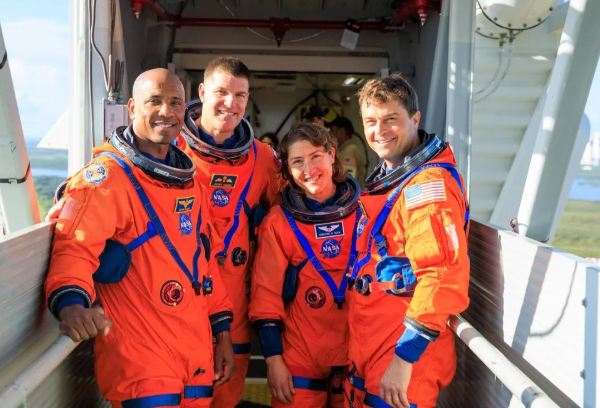
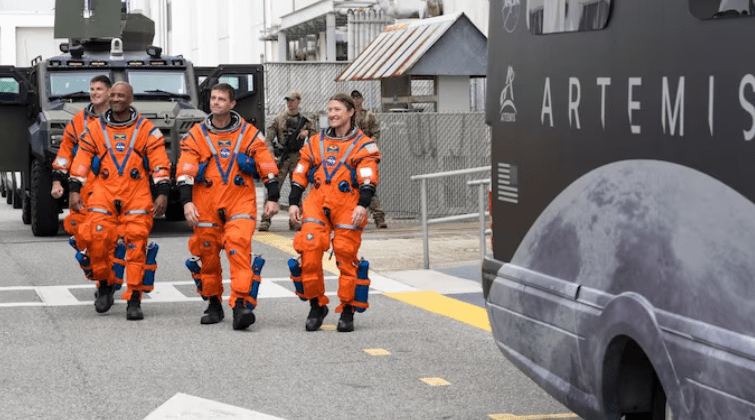
The crew includes NASA astronauts Reid Wiseman, Victor Glover, and Christina Koch, along with Canadian Space Agency astronaut Jeremy Hansen. They are traveling aboard Orion, which launched on April 1 using NASA’s Space Launch System rocket from Kennedy Space Center in Florida. After launch, the spacecraft completed engine burns to exit Earth’s orbit and head toward the Moon.
Artemis II hits major milestone as NASA conducts full SLS fueling rehearsal
Artemis II is a key test mission for future lunar exploration. At its farthest point, Orion is expected to reach about 252,760 miles from Earth before beginning its return journey, helping NASA evaluate deep space travel systems and spacecraft performance.
Orion Spacecraft Journey, Moon Flyby, and Deep Space Operations
The Orion spacecraft is continuing its journey around the Moon as part of NASA’s Artemis II crewed test flight. Several days into the mission, the spacecraft is steadily moving farther from Earth while carrying out important navigation checks and communication operations.
A key phase of the mission is the close lunar flyby. During this maneuver, Orion is expected to pass about 4,070 miles from the Moon’s surface. This close approach allows the spacecraft to use the Moon’s gravity to adjust its path and test navigation systems in deep space conditions.
The mission also includes a historic moment, as the astronauts will become the first humans to travel behind the far side of the Moon. During this time, communication with Earth will be cut off for around 40 minutes. This happens because the Moon blocks radio signals between Orion and NASA’s Deep Space Network.
Moon resources in high demand among powerful nations.
This planned communication blackout is an important test of spacecraft reliability and mission readiness. Once Orion moves back into view from behind the Moon, contact with mission control at NASA’s Johnson Space Center in Houston will be restored.
During the flyby, Orion’s onboard cameras and handheld devices are capturing high-resolution images of the lunar surface, including areas never seen closely by humans. These observations help scientists study the Moon’s terrain, lighting, and features in greater detail for future missions.
Crew Experience, Scientific Imaging, and Spaceflight Milestone Observations
Inside the Orion spacecraft, the four Artemis II astronauts continue to carry out mission tasks while documenting their deep space journey. They are taking photographs of both the Moon and Earth, creating valuable visual records from one of the most distant human spaceflights in history.
Canadian Space Agency astronaut Jeremy Hansen shared remarks from aboard Orion after the crew crossed the record-breaking distance from Earth. He reflected on the achievement and highlighted the importance of earlier space missions that paved the way for this milestone.
During the mission, the crew has also discussed symbolic ideas, including possible names for lunar surface features observed during the flyby. One proposed name is linked to the spacecraft itself, while another carries personal significance for an astronaut. These proposals will later be reviewed by the International Astronomical Union, which is responsible for naming celestial features.
NASA shifts Artemis II launch dates after fuel system seals fail critical stress tests
NASA has stressed that Artemis II is focused not only on records but also on collecting scientific and technical data. Details on spacecraft performance, communication systems, and astronaut observations are being carefully recorded for analysis.
The astronauts are also using handheld cameras to capture high-resolution images of the Moon’s surface under different lighting conditions. These images help scientists study terrain, shadows, and geological features that are difficult to observe from Earth, while Orion continues to function as a key test platform for future deep space missions.