

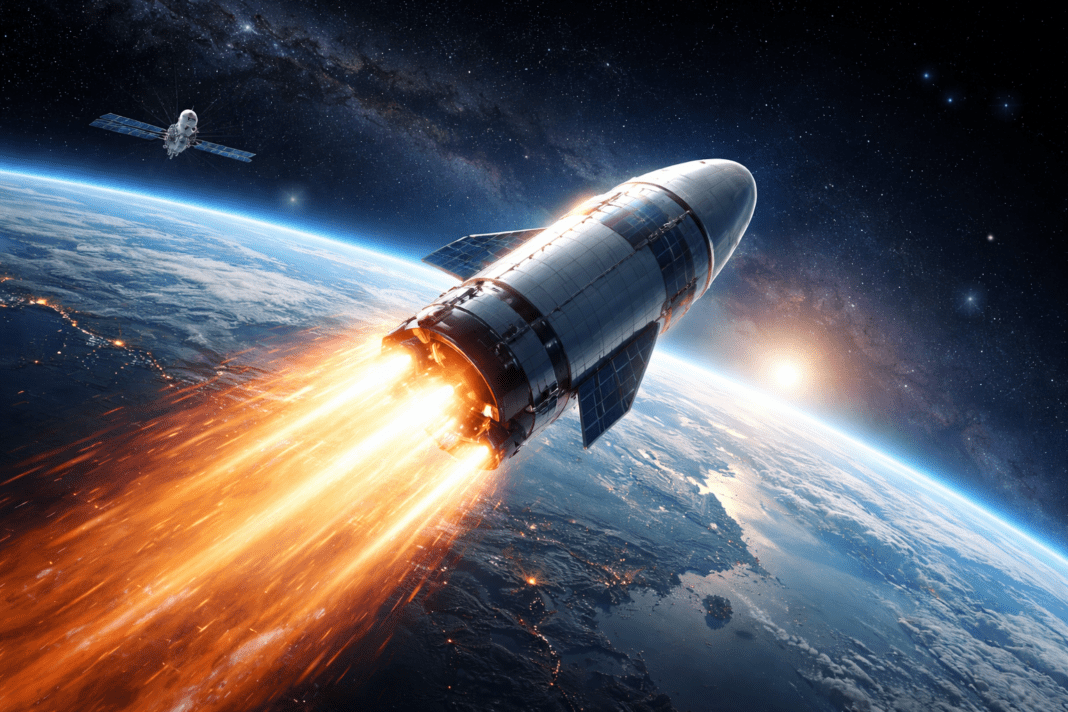

For many years, space missions focused on one main goal—sending rockets and satellites into space. That challenge has largely been solved. Today, countries, private companies, and emerging players like Inbound Aerospace can launch payloads into orbit more regularly than ever before.
But a new question is now taking center stage: what happens after something reaches space?
A New Kind of Space Mission: Not Just Going Up, But Coming Back
This is where Inbound Aerospace, a company based in Chennai, India, is stepping in with a powerful idea. Instead of only sending experiments to space, the company is building special spacecraft that can bring materials safely back to Earth. These are called return vehicles or recoverable spacecraft.
This approach is important because many valuable experiments conducted in space cannot be fully used unless they are returned. Without a reliable way to bring them back, much of the potential of space research remains untapped.
Inbound Aerospace is working on compact, reusable spacecraft designed to carry scientific experiments into orbit, keep them in microgravity for several weeks, and then return them safely. These vehicles are being designed to handle delicate materials, ensuring that they are not damaged during re-entry into Earth’s atmosphere.
The company is planning to carry out its first launch in 2028, marking a key milestone for India’s private space sector and for the future of return-based space missions.
The idea may sound simple, but it represents a major shift in how space missions are planned and executed.
Why Returning From Space Matters for Science and Medicine
Space offers a unique environment called microgravity, where the effects of gravity are extremely weak. In this environment, many natural processes behave differently than they do on Earth.
For example, when scientists try to grow protein crystals on Earth, gravity affects their shape and quality. But in space, without gravity pulling things down, these crystals can form more perfectly. This leads to better results in medicine, especially when designing drugs.
Inbound Aerospace’s return vehicles are built to support such experiments. Scientists can send materials into space, allow them to develop in microgravity, and then bring them back for detailed study.
Space Radiation: Confronting Risks with Vigor
This has important uses in several areas:
- Medicine: Space-grown materials can help create more effective drugs with improved performance.
- Biotechnology: Researchers can study cells, tissues, and biological systems in new ways.
- 3D Bioprinting: In space, it is possible to print human tissues without needing support structures, because there is no gravity to pull them down.
- Microbiology: Bacteria and other organisms behave differently in space, helping scientists understand diseases better.
Another key advantage is the ability to return fragile experiments safely. Many current space capsules are not designed to handle sensitive materials. Inbound Aerospace is working on systems that ensure gentle re-entry, reducing damage and preserving the quality of the research.
The spacecraft being developed is expected to carry around 100 kilograms of payload in a compact space roughly the size of a cube. It is also being designed to allow different types of experiments, including those that need a pressurized environment and those that can be exposed to space.
Building India’s Role in the Growing Space Economy
India is already known for its cost-effective space missions and strong presence in the global pharmaceutical industry. With companies like Inbound Aerospace, the country is now entering a new phase—connecting space technology with biotechnology.
One of the biggest challenges in space research today is limited access to microgravity for long durations. Many experiments need weeks, not just minutes or hours, to show meaningful results. Inbound Aerospace aims to solve this by offering sustained microgravity conditions for up to eight weeks.
Another challenge is the lack of frequent and flexible launch options. The company plans to use smaller rockets to enable launch-on-demand services, making it easier for researchers to send experiments into space when needed.
There is also a growing shift globally from government-led space missions to private sector participation. Companies around the world are building platforms for research in orbit, and Inbound Aerospace is positioning itself as a key player by focusing on transport and return services.
The company is not directly conducting experiments but is partnering with organizations worldwide to carry their payloads. Its planned 2028 launch timeline reflects the rapid progress being made in developing its spacecraft and systems.
India moves to involve private startups in guardian satellites to protect key space assets
At the same time, India is strengthening its ecosystem with policies, research programs, and collaborations that support innovation in both space and biotechnology. Initiatives promoting microgravity experiments and private participation are helping create opportunities for startups like Inbound Aerospace.
A critical aspect of this development is the need for better infrastructure and clear regulations, especially for re-entry and recovery of spacecraft. These areas are still evolving, but progress is being made as the industry grows.
Inbound Aerospace’s work highlights a simple but powerful idea: space is not just a place to explore—it is also a place to create valuable products. And bringing those products back to Earth is the key to unlocking their full potential.