

India’s private space sector is gearing up for a key milestone with the launch of the GalaxEye Drishti mission. The satellite, powered by advanced OptoSAR technology, aims to enhance Earth observation using next-generation imaging capabilities and marks a major step in the growth of India’s private space capabilities.
What is the GalaxEye Drishti Mission Satellite
India’s private space sector is preparing for a major milestone as GalaxEye Space Solutions Private Ltd gets ready to launch its “Drishti” mission satellite. The spacecraft is designed to improve Earth observation by capturing clearer and more frequent images of the planet. It marks an important step for India’s growing private space industry.
This satellite is the heaviest built so far by an Indian private space company, weighing around 190 kilograms. Its size is roughly comparable to a fully grown adult along with a large motorcycle. The mission is also the first step toward a planned constellation of 10 satellites that will work together in space using OptoSAR.
Critical space security measures become essential for India to maintain military readiness
Once operational, the system will continuously monitor Earth and send data back to the ground. It can track changes across land, oceans, forests, cities, and disaster zones, capturing images with a resolution of 1.2 to 3.6 meters. The satellite will operate in low Earth orbit at about 500 kilometers above the planet, powered by OptoSAR.
How the 2-in-1 OptoSAR Technology Works
One of the most important features of this satellite is its advanced 2-in-1 system called OptoSAR, which is the core innovation of the mission. OptoSAR is what makes the satellite stand out from most other Earth observation systems currently in use around the world.
Normally, satellites rely on only one type of imaging system. Optical cameras work like regular cameras and capture images using sunlight. These images are usually very clear and easy to understand, but they have a major limitation. They cannot see through thick clouds, and they stop working properly at night when there is no sunlight available.
On the other hand, radar systems solve this problem by working in all weather conditions and even in complete darkness. They send signals toward Earth and create images based on the reflections that bounce back. However, radar images are often more complex and less natural-looking, making them harder for people to interpret quickly.
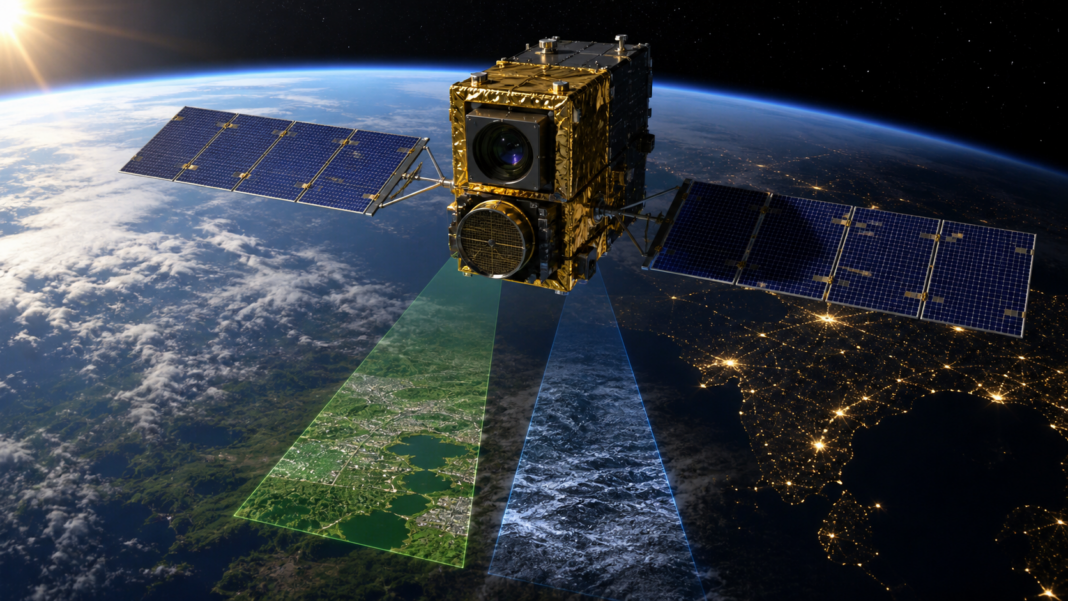
OptoSAR combines both of these technologies into a single integrated platform. The satellite carries an optical sensor along with a synthetic aperture radar (SAR) system at the same time. This allows OptoSAR to collect data continuously, regardless of weather or lighting conditions.
With the help of OptoSAR, advanced software and artificial intelligence process and merge both data types. It corrects small movements in space, reduces errors, and produces clearer, more accurate images that are easier to understand.
Launch Details and Mission Capabilities
The satellite will be launched aboard a Falcon 9 rocket operated by SpaceX, a vehicle widely used for international missions. The launch, linked with the CAS500-2 mission, will take place from Vandenberg Space Force Base in California, targeting low Earth orbit with OptoSAR-enabled operations.
The primary launch window is set for May 2, with a backup opportunity on May 3. Once in space, the satellite will operate for around four to five years, collecting continuous Earth data through OptoSAR and sending it back for analysis.
India moves to involve private startups in guardian satellites to protect key space assets
It is designed to revisit the same location on Earth every four days, helping monitor urban growth, farming patterns, forests, and natural disasters. The system relies heavily on OptoSAR, along with onboard and ground-based computing, where artificial intelligence helps process and refine data.
The mission is supported within India’s commercial space ecosystem to distribute imagery for multiple uses, including government work, defence, agriculture, urban planning, and mapping services. The project has taken more than 1,600 days of development, with engineers building and refining OptoSAR-based systems in India.