

A rare and unusual space event is capturing attention as a leftover booster from SpaceX’s Falcon 9 rocket is heading toward a high-speed collision with the Moon. The object, which did not return to Earth as planned, has been drifting through space and is now on a direct path toward the lunar surface, highlighting the growing presence of human-made debris beyond Earth’s orbit.
A Rocket Booster Drifting Toward an Unexpected Collision
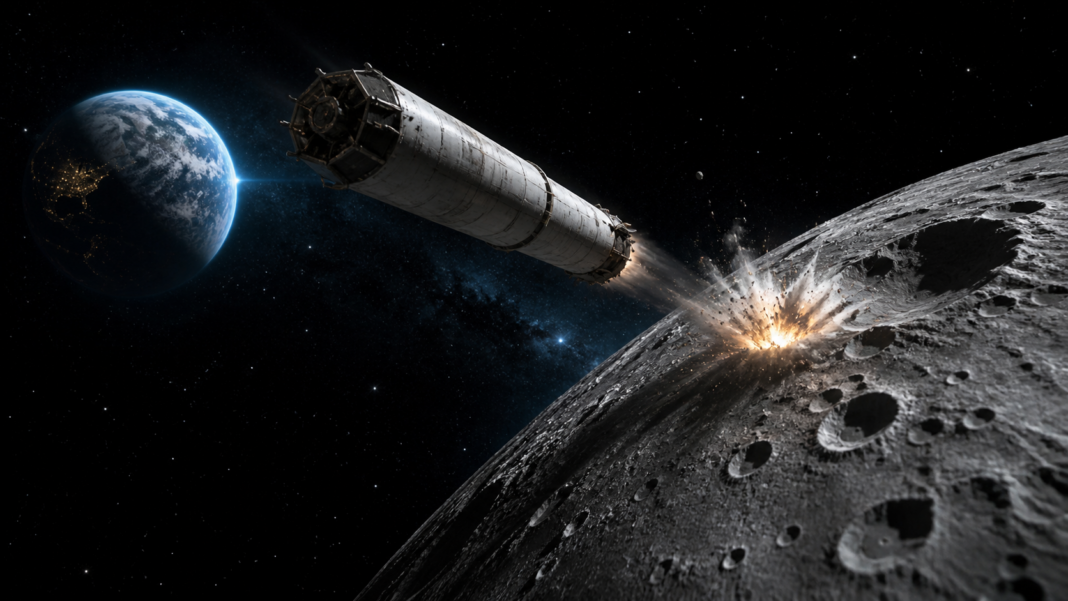
A stray piece of a SpaceX Falcon 9 rocket is on course to collide with the Moon at several times the speed of sound. This unexpected collision is expected in early August, attracting attention from scientists and space observers worldwide.
The booster was launched in January 2025 to carry private lunar landers. After completing its mission, it was meant to return to Earth and burn up safely, but it failed to do so, leading to a possible collision scenario in space.
All eyes on May 1 as SpaceX prepares Falcon 9 launch from Cape Canaveral
Instead, the booster drifted into a long orbit, traveling as far as 310,000 miles from Earth. Its path eventually crossed the Moon’s trajectory, setting the stage for a rare and powerful collision event.
Complex Space Forces Alter the Booster’s Path
The journey of the booster has been far from simple, as its path through space has been shaped by several powerful forces. Its movement has been influenced by the gravity of Earth, the Sun, and the Moon. These gravitational pulls constantly act on objects in space, slightly changing their direction over time. Because of this, predicting the exact path of the booster becomes very difficult, increasing the chances of an unexpected collision.
Another important factor is solar radiation pressure. This occurs when tiny particles of light, known as photons, are released by the Sun and strike the surface of the booster. Each impact is extremely small, but over long periods, these forces build up and slowly push the object away from its original path. This gradual shift plays a significant role in altering its trajectory and adds to the uncertainty of where it will end up.
Due to these combined forces, scientists are confident that the booster will eventually collide with the Moon, but they cannot determine the exact location with full accuracy. The expected impact area is near the Einstein Crater on the Moon’s far western side, a region that is difficult to observe from Earth.
At the time of impact, the booster is expected to be traveling at around 5,400 miles per hour. This high-speed collision is likely to create a noticeable crater, adding to the Moon’s surface features and helping scientists better understand such impact events.
Growing Concerns About Space Debris Beyond Earth
This is not the first time a human-made object has been predicted to crash into the Moon. In recent years, there have been similar incidents where old rocket parts or spacecraft fragments ended up hitting the lunar surface. In one notable case, the impact created two craters instead of one, surprising scientists and showing how unpredictable these collisions can be. As more missions are launched by different countries and private companies, such events are slowly becoming more frequent.
The situation highlights growing concerns about space debris. Most discussions usually focus on junk orbiting Earth, but this event shows that the problem is extending beyond our planet. Objects left drifting in space after completing their missions can travel for long periods and eventually collide with moons, planets, or even active spacecraft.
SpaceX schedules Falcon 9 launch from Cape Canaveral following unusual southeast trajectory
Space agencies like NASA and others are working on plans to send humans back to the Moon. As the number of missions increases, the presence of uncontrolled debris could become more significant and harder to manage safely.
Although this particular crash does not pose any immediate danger, it clearly shows how leftover rocket parts can remain in space long after their missions are complete. These objects can move unpredictably, and even in the vastness of space, collisions can still happen when their paths intersect.