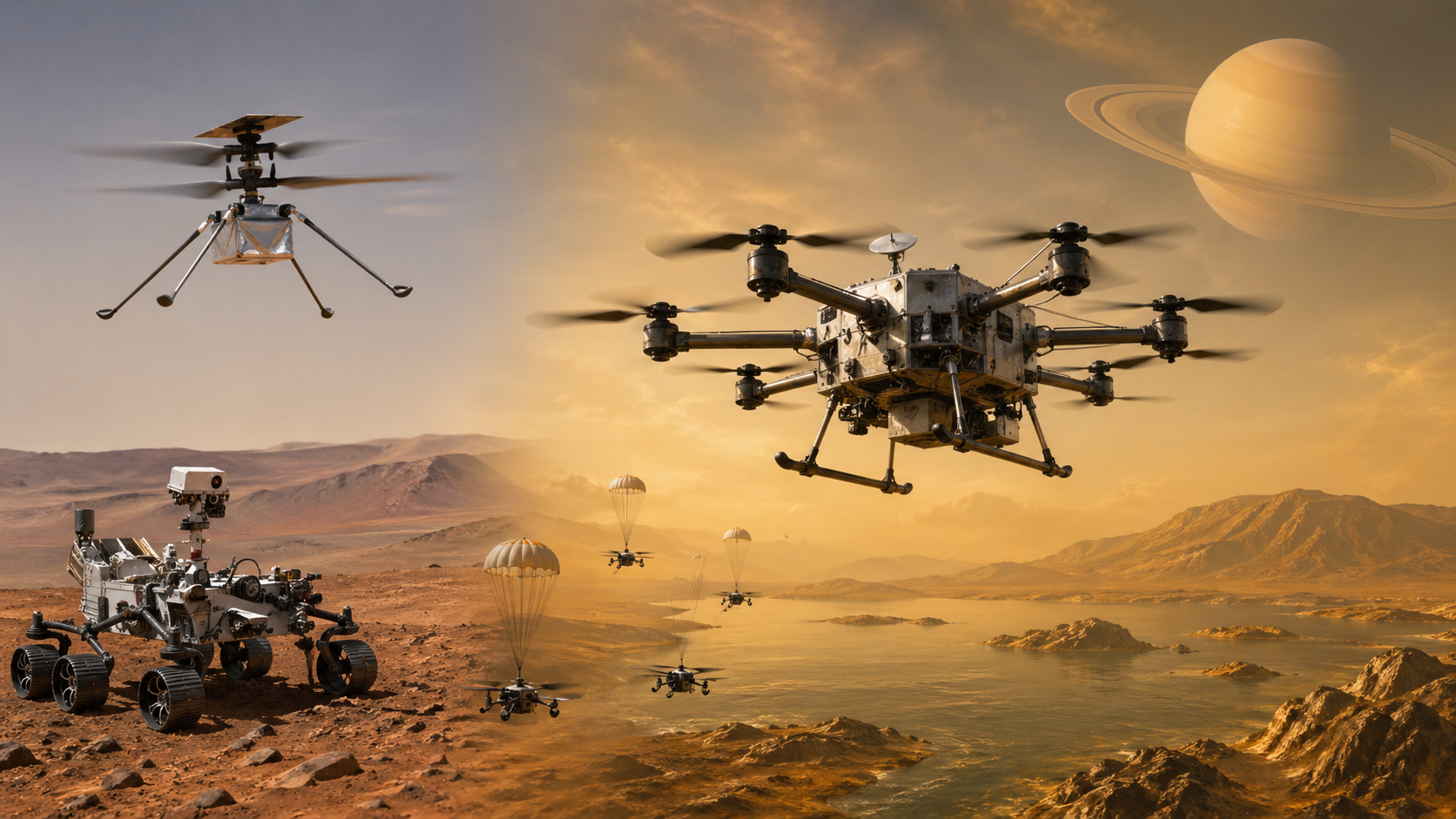
Space exploration is entering a new phase as flying robots move from simple experiments to powerful tools. What began with a small helicopter on Mars has quickly evolved into advanced missions designed to explore distant worlds like Titan, changing how scientists study the solar system.
A Small Helicopter That Changed Space Exploration
For decades, spacecraft sent by NASA followed a simple pattern: they either stayed where they landed or moved slowly on wheels. This changed in April 2021 when Ingenuity made history on Mars. Weighing just four pounds, it lifted off from Jezero Crater, hovered briefly, and landed safely, becoming the first aircraft to achieve powered flight on another planet.
Originally planned as a short 30-day test with only five flights, the mission went far beyond expectations. Ingenuity remained active for nearly three years, completing 72 flights and traveling more than 17 kilometers. It proved that flying in Mars’ thin atmosphere was not only possible but also reliable.
Mars rock samples become focus of China’s successful 2031 return strategy
The helicopter also supported the Perseverance rover by scouting terrain and identifying safer routes. Its mission ended in early 2024 after a hard landing damaged its blades, but it had already changed how space exploration is approached.
A Giant Flying Robot Is Now Being Built for Titan
After the success of the small Mars helicopter, NASA has moved forward with a much larger and more advanced flying mission called Dragonfly. This new robotic drone is being built to explore Titan, one of the most unique and mysterious worlds in the solar system.
Dragonfly is dramatically bigger than the earlier helicopter. It weighs around 875 kilograms, similar to a small car, and features eight rotors arranged in pairs to maintain stability during flight. Unlike the Mars helicopter, which relied on solar panels, Dragonfly is powered by a nuclear energy source. This allows it to operate continuously in Titan’s dim environment, where sunlight is very weak due to its distance from the Sun.
NASA Clarifies No Emergency on ISS
The mission is scheduled to launch in 2028 and is expected to arrive at Titan in 2034. Once it lands, Dragonfly will begin a science mission lasting more than three years. Engineers have already made strong progress, completing key steps such as assembling the main structure, testing the parachute landing system, and preparing instruments that will study Titan’s surface and atmosphere.
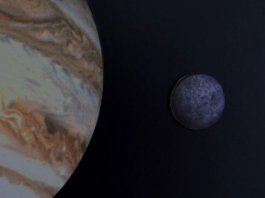
Titan offers ideal conditions for aerial exploration. Its thick nitrogen-rich atmosphere and low gravity make flying easier than on Mars. The moon also has rivers and lakes of liquid methane and complex organic materials, making it an important place for scientific study.
Mars Helicopters Are Also Getting Bigger and Smarter
While much of the focus is on the mission to Titan, plans for Mars exploration are also advancing quickly. Scientists working with NASA are developing a new generation of helicopters that are larger, more capable, and designed to support detailed scientific missions on the Red Planet.
One of the most important concepts is the Mars Chopper. This helicopter is far bigger than earlier designs and is built to carry several kilograms of scientific instruments. It is expected to fly several kilometers in a single Martian day, allowing it to reach places that are too steep, rocky, or dangerous for traditional rovers.
SpaceX pivots from Mars as Elon Musk backs fast-track plan for self-growing city on the Moon
Another concept, called SkyFall, introduces a new strategy. Instead of sending one aircraft, this mission aims to deploy multiple helicopters at once. These machines would be released mid-air and spread across different regions of Mars, enabling scientists to study a wider area in a shorter time.
The goal of these helicopters is to search for water ice beneath the surface and identify safe landing zones for future missions. Their ability to fly quickly and navigate difficult terrain gives scientists a powerful new tool for exploring Mars in greater detail.